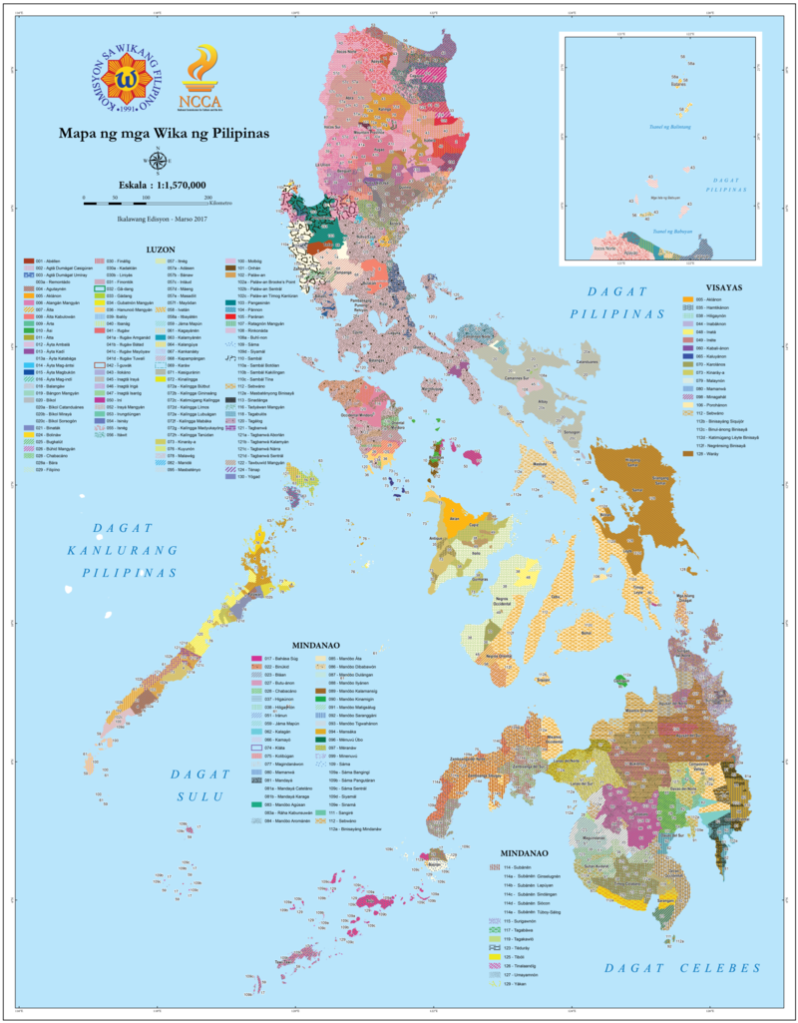
The Philippine languages or Philippinic are a proposed group by R. David Paul Zorc (1986) and Robert Blust (1991; 2005; 2019) that include all the languages of the Philippines and northern Sulawesi, Indonesia—except Sama–Bajaw (languages of the “Sea Gypsies”) and the Molbog language—and form a subfamily of Austronesian languages. Although the Philippines is near the center of Austronesian expansion from Taiwan, there is relatively little linguistic diversity among the approximately 150 Philippine languages, suggesting that earlier diversity has been erased by the spread of the ancestor of the modern Philippine languages.
According to Ethnologue, a total of 182 native languages are spoken in the nation and four languages have been classified as extinct: Dicamay Agta, Katabaga, Tayabas Ayta and Villaviciosa Agta. Except for English, Spanish, Chavacano and varieties of Chinese (Hokkien, Cantonese and Mandarin), all of the languages belong to the Malayo-Polynesian branch of the Austronesian language family.
The following are the four Philippine languages with more than five million native speakers:
- Tagalog
- Cebuano
- Ilocano
- Hiligaynon
In addition, there are seven with between one and five million native speakers:
- Bicolano
- Waray
- Kapampangan
- Pangasinan
- Maguindanao
- Maranao
- Tausug
One or more of these is spoken natively by more than 90% of the population.
 American Pinoy
Leave a comment